
How Does A Police Stinger Work?

Police stingers, also known as tire deflation devices, are a tool used by law enforcement agencies to stop vehicles that are evading the police or engaging in other criminal activity.
A police stinger is a spike strip that is deployed on the road to puncture the tires of a targeted vehicle.
In this blog post, we will explore how a police stinger works, its effectiveness, and safety considerations.
Related Questions
-
A police stinger is a device used by law enforcement to stop fleeing vehicles during high-speed pursuits.
-
Police officers are trained to deploy spike strips, also known as tire deflation devices or stingers, in a safe and effective manner.
The process of deploying a spike strip typically involves the following steps:
Assess the Situation: Before deploying a spike strip, officers must assess the situation to determine if it is safe to do so.
This may involve considering factors such as the speed of the targeted vehicle, the road conditions, and the presence of other motorists or pedestrians.
Select the Appropriate Location: Once officers have determined that it is safe to deploy a spike strip, they must select an appropriate location to place the strip.
The strip should be placed in a location where the targeted vehicle is likely to drive over it, such as on a straightaway or at an intersection.
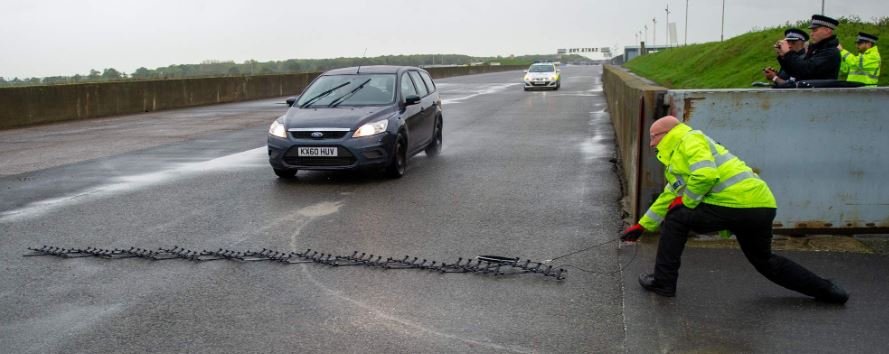
Deploy the Spike Strip: When the targeted vehicle is approaching the location where the spike strip has been placed, officers will deploy the strip by quickly unrolling it across the road.
The strip should be placed perpendicular to the direction of travel, with the spikes facing up.
Retract the Spike Strip: After the targeted vehicle has passed over the spike strip, officers will quickly retract the strip to prevent other vehicles from driving over it and to avoid damaging the strip itself.
Secure the Spike Strip: Once the spike strip has been retracted, officers will secure it to prevent it from becoming a hazard to other motorists or pedestrians.
This may involve folding it up or placing it in a secure container.
It is important to note that deploying a spike strip carries risks and should only be done by trained law enforcement officers.
Officers must also follow specific protocols and guidelines when deploying a spike strip to ensure that it is used safely and effectively.
-
Stop sticks, also known as tire deflation devices or spike strips, are a tool used by law enforcement agencies to stop vehicles that are evading the police or engaged in other criminal activity.
Stop sticks are similar to spike strips in that they puncture the tires of a targeted vehicle, but they operate slightly differently.
Stop sticks are designed to be thrown in front of a targeted vehicle as it approaches, rather than being deployed across the road like spike strips.
The stop stick is a flexible tube that contains dozens of sharp metal spikes.
When the stop stick is thrown in front of a vehicle, the spikes puncture the tires as the vehicle drives over it.
Stop sticks are designed to be lightweight and easy to deploy, which makes them ideal for use in situations where a police vehicle is pursuing a fleeing vehicle.
The stop stick can be thrown from the window of a moving police vehicle, allowing officers to deploy it quickly and safely.
Once a vehicle's tires have been punctured by a stop stick, it becomes much more difficult to control and drive, and the driver is typically forced to slow down and eventually come to a stop.
Like spike strips, stop sticks carry risks and safety considerations, and their use must be carefully regulated and controlled by law enforcement agencies.
-
A police stinger is made up of several rows of hollow spikes that are designed to puncture the tires of a vehicle.
The spikes are connected to a cable that is laid across the road.
When a fleeing vehicle drives over the cable, the spikes puncture the tires, causing the vehicle to slow down and eventually come to a stop.
-
Yes, a police stinger can be dangerous if not used properly. If a vehicle is traveling at a high rate of speed and hits the stinger, it can cause the vehicle to spin out of control or flip over.
It is important for law enforcement to use the stinger in a controlled environment to minimize the risk of injury or death.
-
If a vehicle hits a police stinger, the spikes will puncture the tires, causing the vehicle to slow down and eventually come to a stop.
Depending on the speed of the vehicle, hitting the stinger could cause the vehicle to spin out of control or flip over.
-
Yes, police sting operations are legal as long as they are conducted in accordance with the law.
Law enforcement agencies must obtain proper authorization and follow strict guidelines when conducting a sting operation.
-
A police stinger can be used on motorcycles, but it is not recommended.
The spikes can easily puncture a motorcycle tire, causing the rider to lose control and potentially crash.
-
If you encounter a police stinger during a pursuit, slow down and avoid driving over the cable if possible.
If you cannot avoid the stinger, continue driving at a safe speed until you can safely pull over and stop.
Do not attempt to flee from law enforcement or engage in any reckless driving behaviors.


Mechanics of A Police Stinger

A police stinger is typically made of a heavy-duty plastic or rubber strip that is lined with dozens of sharp metal spikes.
The spikes are designed to puncture the tires of a targeted vehicle when it drives over the strip.
The strip is usually between 10 and 30 feet long and can be deployed quickly by law enforcement officers.
When a police stinger is deployed, it is typically placed in the path of the targeted vehicle. The vehicle drives over the strip, and the spikes puncture the tires, causing them to rapidly deflate.
As the tires lose air, the vehicle becomes more difficult to control, and the driver is forced to slow down and eventually come to a stop.
Police Stinger Effectiveness

Police stingers can be highly effective in stopping fleeing vehicles and bringing dangerous situations to a close.
When a vehicle's tires are punctured by a police stinger, it becomes much more difficult to control and drive, and the vehicle is typically forced to come to a stop within a short distance.
However, police stingers are not foolproof, and there are situations where they may not be effective.
For example, if a vehicle is traveling at a high speed, it may be able to continue driving for some distance even with deflated tires.
In addition, if a vehicle is equipped with run-flat tires or reinforced sidewalls, it may be able to continue driving even after the tires have been punctured.
Safety Considerations
While police stingers can be effective in stopping fleeing vehicles, they also carry risks and safety considerations.
The use of a police stinger can cause a vehicle to become unstable and difficult to control, which can pose a risk to the driver, passengers, and other motorists on the road.
To minimize the risks associated with police stingers, law enforcement agencies typically have strict policies and procedures in place for their use.
Officers are trained in the proper deployment of stingers and are required to follow specific protocols when using them.
In addition, police stingers are typically only used in situations where the risks to public safety outweigh the risks of using the stinger.
For example, a stinger may be used in a situation where a fleeing vehicle is posing an immediate threat to the public, but it may not be used in a situation where the vehicle is simply speeding or evading a traffic stop.
Legal Considerations

The use of a police stinger also raises legal considerations, particularly regarding the Fourth Amendment to the U.S. Constitution, which protects citizens from unreasonable searches and seizures.
The use of a police stinger may be considered a seizure of the vehicle, and law enforcement agencies must have a legal basis for using a stinger, such as probable cause that the vehicle is engaged in criminal activity.
In addition, law enforcement agencies must comply with state and local laws regarding the use of police stingers.
The use of stingers may be subject to specific regulations, and officers must follow these regulations to ensure that their actions are legal and constitutional.
Conclusion
In conclusion, police stingers are a tool used by law enforcement agencies to stop fleeing vehicles and bring dangerous situations to a close.
They work by puncturing the tires of a targeted vehicle, causing it to become more difficult to control and eventually come to a stop.
While police stingers can be effective, they also carry risks and safety considerations, and their use must be carefully regulated and controlled by law enforcement agencies.
The use of a police stinger may be subject to legal considerations, and law enforcement agencies must have a legal basis for using a stinger, such as probable cause that the vehicle is engaged in criminal activity.
Overall, the use of a police stinger is a necessary tool for law enforcement agencies in certain situations, such as when a vehicle is posing an immediate threat to public safety.
However, the use of a police stinger carries risks and must be carefully regulated and controlled to ensure that it is used appropriately and in accordance with the law.
Recent Questions:





Inside the Investigation: A Deeper Dive into Police Detective Benefits